15% of Your Users Just Opened a Second Trading App. That's $180M Walking Out the Door.


The question isn't whether to offer trading, it's whether to offer everything.
Every decade, a new asset class becomes accessible to everyone. Platforms that adapt the fastest win. The ones protecting their old model? They become case studies in business school.
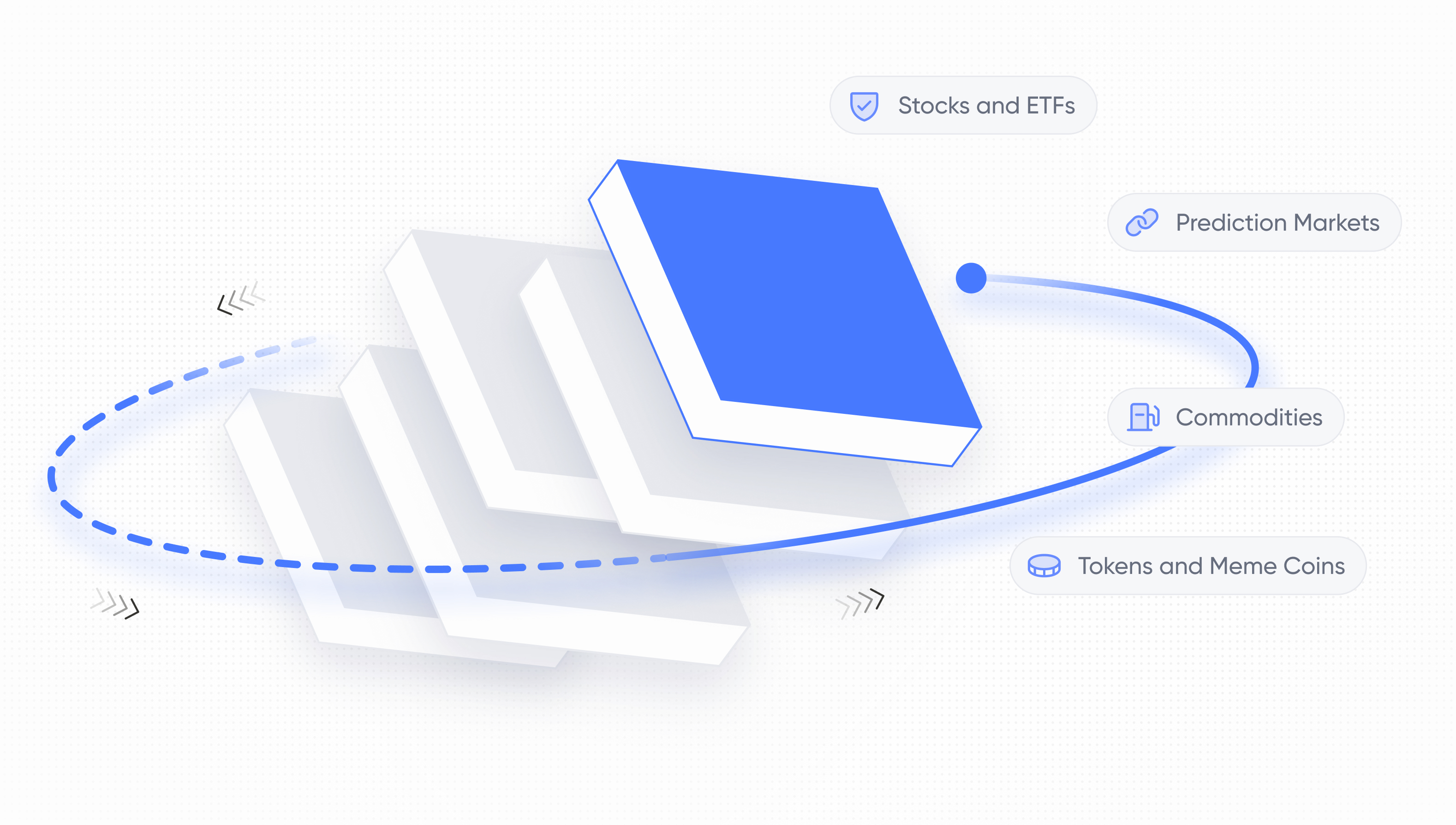
The 2026 shift is already here. Trading is moving onchain across the entire spectrum: Superstate and Ondo Finance are tokenizing Treasury bonds and credit, giving institutions programmable access to traditional assets. Perpetual futures markets are processing billions daily.
Cultural moments are becoming tradable assets within hours of going viral. All of it, 24/7, instantly accessible. The question isn't whether to offer stablecoins, it's whether to offer everything.
The Pattern: A Brief History of "That'll Never Work"
1994-2000s: "Nobody Wants to Trade Online"
In the 90s, trading through a broker cost $100-300 and required an actual phone call during business hours. Like calling the DMV, but more expensive.
By 1997, Ameritrade offered $8 online trades. Merrill Lynch called online trading suitable only for "gamblers" and kept their phones ringing. By 2000, they'd lost so much market share they launched their own discount platform. Regional brokerages without national scale got acquired for pennies or just shut down.
The lesson: When distribution costs collapse, access becomes everything.
2013-2019: "Commission-Free Trading Can't Be Sustainable"
Robinhood launched commission-free trading in 2013. The industry was certain it was a gimmick.
ETRADE, TD Ameritrade, and Schwab spent six years explaining why their $5-10 commissions were justified by superior service. Meanwhile, Robinhood hit 10 million users. In October 2019, all three eliminated commissions on the same day. TD Ameritrade sold to Schwab. ETRADE sold to Morgan Stanley.
Six years is not a long time to rethink your business model. Unless you're being disrupted, in which case it's an eternity.
The lesson: When your revenue model gets disrupted, you have maybe 18 months. Not six years.
2020-2024: "Retail Investors Don't Belong in Private Markets"
Angel investing required $25K+ checks and accreditation requirements. Then platforms like AngelList, Republic, and Kalshi removed those barriers.
Traditional angel networks and PE firms assumed regulation would protect their exclusivity. It didn't. AngelList deployed hundreds of millions from non-traditional investors. When regulatory clarity arrived, the incumbents had built exactly zero infrastructure to serve retail. Market: ceded.
The lesson: "They can't legally do that" is a bad moat, as regulation of emerging industries is constantly changing.
2025: The Onchain Wave (And Who's About to Lose)
This year's barrier being removed: custody overhead, regulatory delays, and chain-specific complexity.
What's opening: Instant access to perpetual futures, meme coins, cross-chain tokens, tokenized stocks- 24/7, globally, without waiting for exchange listings.
The numbers:
- Robinhood generated over $100M from prediction markets in their first year
- Hyperliquid processes billions in perpetual futures volume daily
- Polymarket did $3.7 billion in volume in the 2024 US election and has hit record monthly numbers just last month
- Kraken expanded to onchain/meme coin trading and stock trading with Inky
- Magic Eden expanded from NFTs to cross-chain token trading
Who's Losing Right Now: Regional Trading Apps
If you're a Chime, Interactive Brokers, Mercury, EToro, Trade Republic, or any regionally tied brokerage or exchange, you're facing a real problem: your users want to trade things you don't offer.
When prediction markets open on the Super Bowl, or when a new perpetual futures market goes live, your users open Robinhood or Coinbase accounts to get that trade.
The custody trap: Traditional exchanges can only offer assets they custody. That means 6-12 month integration cycles, legal review for every new asset, and impossible reaction times to cultural trading moments.
Meanwhile, new apps and Robinhood give users instant access to any token. Robinhood added prediction markets in months, not years. Also, they are incorporating social interactions to create the viral loops your app hasn’t even dreamed of supporting.
The Math on Bleeding Users
Conservative assumptions:
- 15% of your users trade elsewhere monthly for assets you don't offer
- Each generates $50 in monthly fees
- You have 2 million active users
That's $180 million in annual revenue happening on platforms that aren't yours. These users are still "your customers," but their wallet share is shifting. In 18 months, they won't come back.
Regional apps face a bigger threat: when Robinhood enters your market offering perpetuals, predictions, meme coins, and traditional assets in one app–what's your defense?
Why Now? And Why UX No Longer Blocks This
For years, crypto apps had a problem: users didn't trust them. Clunky interfaces, confusing jargon, hacks, and scams made onchain trading feel like the Wild West. That was the moat protecting traditional exchanges.
That moat is gone.
Trust has been solved. Embedded wallet infrastructure using TSS-MPC now provides the same security and recoverability as custodial systems. Users get wallets with no single point of failure, device recovery, and institutional-grade security without exchanges needing to custody assets.
UI/UX has caught up. Today's crypto-native apps deliver experiences that feel identical to the apps users already trust. Gasless transactions mean users don't need to understand chains or tokens. Cross-chain swaps happen in one click. The experience is seamless, not intimidating.
Compare a modern embedded wallet experience to Coinbase in 2017. It's unrecognizable. The friction that once protected traditional exchanges has been abstracted away.
One Stack to Trade Everything
With Dynamic, you can bring onchain trading directly into your app without constantly rewiring your backend every time a new chain, asset class, or market shows up. One integration unlocks an entire universe of markets.
Instead of pushing users to external exchanges, you keep them in your app with full control over UX, compliance, monetization, and feature velocity.
- Build within your experience. You can bring your own auth, pull from APIs for full control, or white-label Dynamic for speed.
- Provision wallets behind the scenes. Every user gets a secure, non-custodial wallet. Start with one chain or go multichain from day one. Because the wallet is non-custodial, if an asset exists onchain, your users can hold and trade it. Offer flexible, secure recovery methods so users never lose access.
- Simplify UX with critical wallet features. Ship gasless experiences, enable funding from multiple liquidity sources, and protect users with built-in fraud protection — all without exposing them to crypto complexity.
- Expand your onchain offering instantly. Plug into DeFi yield vaults to offer savings products, add new trading surfaces like perps or prediction markets, and support new asset classes the moment they appear.
The exchanges that win the next decade aren’t the ones negotiating listings; they’re the ones offering everything.
Share this article

.png)