The Trade Everything Stack

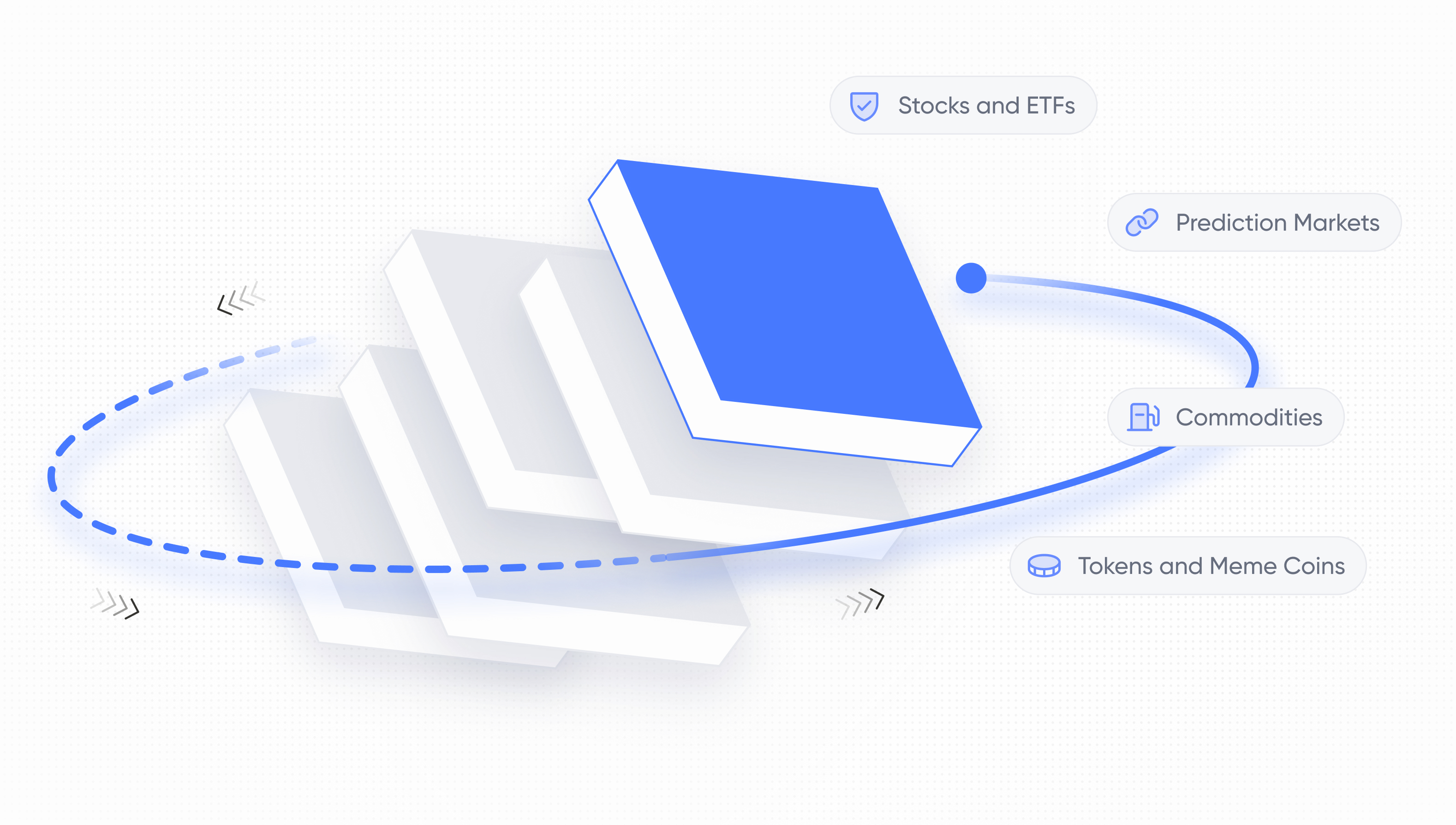
Over the last decade, every trading product has been playing the same game.
Get a user in the door for one thing. Try to keep them for everything.
For Robinhood, that started with commission free stock trading. For Coinbase, with a simple way to buy Bitcoin. For Phantom, with a clean Solana wallet. Each company then spent years expanding the product surface around that initial wedge. Crypto, options, retirement accounts, staking, L2s, NFTs, yield.
Yet even with all that expansion, you still see the same user behavior. People trade in many places. They buy equities here, speculate on meme coins there, hedge with perps somewhere else, use a prediction market for events, and go to a DeFi protocol for yield. Even power users of a single app still move large portions of activity off platform when they want something the platform does not yet support.
For a fintech or exchange, that fragmentation is the central problem. It means you only capture a slice of the user’s wallet, order flow and lifetime value.
The solution is simple to describe but difficult to execute.
Become the one place where they can trade everything.
This is the Trade Everything Stack. And importantly, it is not a far future story. It is happening right now.
The Race to Trade Everything is Already Underway
The push toward “every app offers everything” is not hypothetical. You can see it today.
Exchanges are shipping DeFi style yield features that plug into onchain liquidity rather than running everything internally. Bybit Alpha’s liquidity farm is one example, offering access to yield opportunities that look very similar to DeFi, wrapped in a CEX experience.
On the other side, DeFi protocols are becoming more exchange-like with better order routing, deeper liquidity, improved risk engines and cross chain execution.
And at the same time, non-custodial embedded wallet UX has taken a massive leap forward. You now have passkeys, social logins, gas abstraction, sponsor mechanisms and MPC based key management that make a non-custodial wallet feel like a normal fintech app.
The ingredients for a “trade everything world” already exist.
Three Origins, One Identical Destination
You see three archetypes converging:
- Web2 first fintechs, like Robinhood: They began with regulated, custodial rails with equities, options, and ETFs. Their model depends on deepening the trading relationship and capturing more of the user’s wallet over time. When users leave to trade perps, RWAs, or crypto yield, that value disappears from the business.
- Exchanges, like Coinbase: They started with spot crypto and then expanded into L2s, institutional custody, derivatives, staking, stablecoins, and more. Each expansion is a step toward becoming a single multi-asset trading hub that keeps users inside the ecosystem for everything.
- Web3 native products, like Phantom: They began as wallets and evolved into multi-chain gateways offering swaps, bridging, dapp interactions, and asset discovery. Once you own the signing experience, it becomes natural to also become the place where users trade everything available onchain.
Three different starting points. One end state. To reach that end state, a purely custodial internal stack is not enough. You need a second foundation.
Why the Existing Stack Cannot Deliver “Everything”
A fully custodial trading stack is excellent for a narrow set of regulated asset classes. It does not scale cleanly to a world with unlimited asset types and onchain financial primitives.
The limitations are clear:
- Breadth of assets: Offering dozens or hundreds of fast-moving assets becomes unsustainable because each new product requires custom integrations, compliance work, and capital.
- Iteration speed: DeFi protocols ship new markets, collateral types, and primitives far faster than centralized teams can, making it inefficient to compete with thousands of open-source builders.
- Capital and risk scaling: Owning every asset and market in-house creates capital demands and risk surfaces that outpace revenue and become structurally inefficient in an open ecosystem world.
The future is a hybrid model. Your custodial stack remains for the products that must be centralized. Your non-custodial stack powers everything else.
That non-custodial path is the Trade Everything Stack.
The Trade Everything Stack in Four Layers
The stack looks like this:
Experience Layer
This is the interface your users already trust, the place where they log in, deposit fiat, review their portfolio and trade. Expanding into new assets simply means adding new cards or entry points to the same familiar environment, allowing users to access additional markets without learning new workflows or leaving your app.
Wallet and Identity Layer
Every user receives a non-custodial embedded wallet at onboarding, created automatically across multiple chains and secured with MPC while remaining invisible to the user unless you choose to surface it. Authentication feels familiar, control remains intuitive and the underlying complexity stays behind the scenes.
Orchestration and Gas Layer
This layer powers the onchain experience by managing chain selection, signing, gas, fee routing, device keys, recovery, policy rules and risk safeguards in one unified engine. Gasless transactions, simulations, fraud checks, malicious dapp detection and permissioning all operate here, and protocols are brought directly into your wallet rather than asking users to connect to third party apps, ensuring they remain fully inside your environment.
Protocol and Liquidity Layer
This layer connects your embedded wallet to onchain markets such as lending protocols, perps, RWAs, prediction markets, tokenized commodities, yield strategies and liquidity aggregators. You decide which protocols to offer, apply your own filtering and compliance process and present everything through a consistent branded UI so that users interact with simple trading surfaces rather than the underlying protocols themselves.
Together, these four layers make it possible to add new asset classes in weeks instead of years.
A Day in the Life of a Trade Everything User
Let’s make it real.
Imagine Maya. Today she primarily uses your app for stocks and some crypto.
In the trade everything world:
- In the morning she checks her equity portfolio and adjusts a few positions. It feels like any other day on the same familiar custodial rails.
- She scrolls through her dashboard and notices a new “short term yield” card that looks like any other product tile in your core experience. With one tap her stablecoins flow into an onchain yield pool, powered behind the scenes by her embedded wallet with sponsored gas and no blockchain complexity.
- After lunch she spots a “market outlook” card tied to a major geopolitical event and decides to take a small position. Behind the scenes it routes through a Polymarket integration that lives entirely inside your UI.
- Later she taps into tokenized treasuries or commodities through a card that looks like any other feature in your app. Under the hood her embedded wallet executes the position through an RWA protocol.
To Maya, she is still using the same app she trusts. It just keeps offering more. To you, this is the difference between capturing 20 percent of her trading wallet and capturing 80 percent or more.
Why Fintechs and Exchanges Specifically Benefit
If you are Robinhood, Coinbase, Kraken, Public, Revolut or a similar company, the Trade Everything Stack aligns with your core strategy. Here is what this unlocks for your business:
- Dramatic increase in wallet share: You no longer lose users when they want a product you do not yet offer.
- Faster expansion into new categories: You can expose protocol level markets as native experiences without building the entire market infrastructure yourself.
- Better capital and risk efficiency: Protocols manage liquidity, collateral and liquidation. You manage UX, compliance and discovery.
- Regulatory optionality: Non-custodial paths, in many jurisdictions, shift how certain activities are regulated because you are not directly custodying user funds in the same way as a traditional broker. This allows a more flexible product roadmap while staying aligned with oversight expectations.
- A user experience that feels familiar: No seed phrases. No browser extensions. No chain switching. No foreign UIs. Users feel like they are using the same fintech app they have always used, while quietly getting all the benefits of open, programmable financial rails.
This is the strategic unlock. Expand product breadth. Reduce time to market. Increase user value. Protect the core relationship.
Why Most Teams Should Not Build This Alone
Building the Trade Everything Stack in-house is a multi-year journey. It requires:
- Building multi-chain MPC wallet infrastructure with high grade security guarantees.
- Operating a global identity and connectivity layer that works across every device and chain.
- Creating orchestration systems for gas, policy, routing, fraud controls and transaction simulation.
- Integrating with many protocols without fragmenting UX or exposing risk.
- Providing great developer tooling internally so on chain features feel like simple product decisions instead of multi quarter engineering lifts.
Most fintechs and exchanges have the product vision, regulatory expertise and distribution to win this market. But building all of this infrastructure from scratch is not the best use of time or capital.
This is exactly why Dynamic exists. We provide embedded MPC wallets, global identity, gasless orchestration, fraud and simulation tooling, and protocol integrations so your team can focus on the part users actually see and trust.
Crypto as Invisible Infrastructure
The most important piece of this entire story is the one users will never see.
Crypto becomes invisible.
Users will not think “I am using a blockchain product.” They will think “I am trading.” The underlying rails will be decentralized. Assets will be in non-custodial wallets they control. Trades will settle on open, programmable networks. But the interface will feel like the apps they already know.
This is the original vision of crypto finally coming true.
Not by forcing users into new behaviors, but by powering the behavior they already have. The Trade Everything Stack is how we get there.
And if you are building that future, Dynamic would be proud to power it.
Share this article

.png)